No one knows what sounds were played on originally bone flutes, or in which everyday practices and imaginary worlds what we now take for granted as ‘music’ was embedded. Life in the Palaeolithic Age? An existence marked by excessive cruelty. Occasionally a bright note. Otherwise hunger, fear, pain. Perhaps. Perhaps not. One of the few ways to gain vague access to such a distant era is to play its instruments. In Hofheim am Taunus, Germany, in September 2025, you can take part in an archaeomusical adventure with two highly interesting performers.
‘A son, of many shifts, blandly cunning, a robber, a cattle driver, a bringer of dreams, a watcher by night, a thief at the gates, one who was soon to show forth wonderful deeds among the deathless gods’ – this is how the Homeric Hymns, a collection of ancient Greek poems, describe the god Hermes. Shortly after his birth, he leaves the cave in the Kyllene Mountains where he was born as the son of Zeus and the nymph Maia. At the exit, he sees a turtle slowly walking towards him. ‘An omen of great luck for me so soon! I do not slight it. Hail, comrade of the feast, lovely in shape, sounding at the dance! With joy I meet you!’ The young god is delighted, praises his lucky find and carries it home. There he kills the reptile to make a lyre out of it – according to myth, the first musical instrument. The verses also provide information about the construction and materials used: the main component is the colourful turtle shell, assembled with hollow stalks, cowhide and various wooden elements. The instrument is strung with seven strings made of sheep intestine, which Hermes tunes. Then he begins to play music.
The origins of music remain obscure
The dating of the Homeric hymns has not been conclusively clarified. Most of them probably date from the 7th to 5th centuries BC. This makes them some of the oldest surviving texts from Greek antiquity and also contains one of the earliest stories about the origins of music in the Western world. Further accounts of their beginnings can be found in the legends surrounding the Muses, the shepherd god Pan, Athena and Apollo. They are all essentially variations on the same mythical narrative: music and the instruments used to produce it are of divine origin and thus elements of a higher sphere of achievement in which humans can participate but are incapable of producing themselves.

From a scientific point of view, almost nothing is known about the origins of music. They lie somewhere in the illiterate millennia of the Palaeolithic Age. When the first sound generators, in the form of sticks, rattles or drums, actually came into being will probably remain unclear. Made from comparatively unstable materials such as wood, nothing is likely to have survived from these oldest objects. It is now assumed with some certainty that flutes made from bird bones and mammoth ivory, dating back around 40,000 years, are the oldest documented musical instruments in the world. According to current knowledge, around 35,000 years passed between these primal aerophones and the first written sources. This impressive ratio of numerbs clearly illustrates the enormous importance of musical practice in the process of anthropogenesis.

40,000 years of music
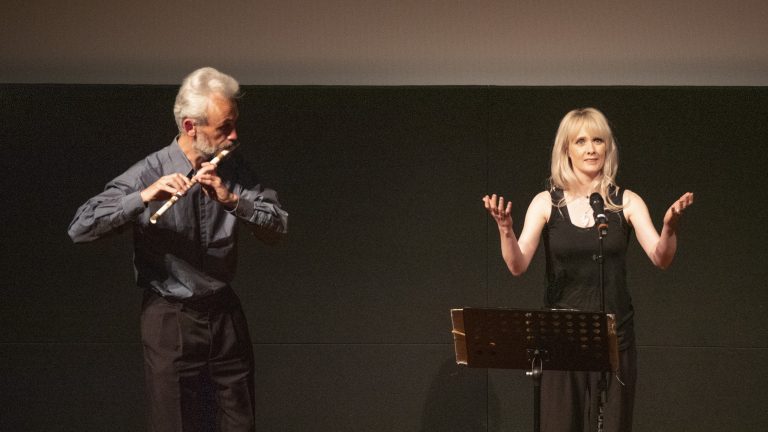
– this is the ambitious title of the opening concert at the 19th Interceltic Folk Festival, which will take place from 11 to 14 September 2025 in Hofheim am Taunus, Germany. The ensemble Lotos Lab, consisting of Stef Conner and Barnaby Brown, deliberately refers to the oldest known instrument finds. However, their performance is not about a condensed history of music from the acoustics of the Upper Palaeolithic to AI-generated playlists, but rather an attempt to make the oldest finds and ancient musical traditions tangible. The instruments used for this purpose comprise a remarkable collection of reconstructions. For example, in addition to flutes made from vulture bones, the ancient aulos and medieval triple pipes are also used. Those familiar with the name Barnaby Brown and his musical commitment will not be surprised that this series is complemented by the Scottish Great Highland Bagpipe, which bridges the aerophone arc into the modern era. The string instruments – Greek lyre and Roman kithara – as well as the vocals are provided by musician, composer and researcher Stef Conner, who bases her compositions on ancient sources.
Thomas Zöller, artistic director and organiser of the event, sees the upcoming concert as the ‘almost perfect opening’ because it touches on the idea of the festival in several ways. ‘The Interceltic Folk Festival is all about facilitating gatherings and creating connections through authentic, handmade and immediate music. This idea is also reflected in Stef and Barnaby’s performance. In addition, the wide musical spectrum covered by the two artists fits in very well with the musical traditions highlighted by the festival,’ says Zöller.

A project for understanding
Founded by Brown in 2022, the Lotos Lab project includes not only concerts but also an instrument workshop. In addition, it serves as a kind of forum for acquiring and exchanging knowledge and experience with musical traditions and ancient instruments. ‘Making. Learning. Performing. Together.’, as the Lotos Lab homepage succinctly puts it. The fourth point deserves special attention here. Because the whole project is driven by an idea that ultimately aims at connection and understanding.
‘Lotos Lab’s vision is of a world in which musical creativity helps us connect in inclusive and playful ways, inter-culturally and inter-generationally. Our mission is to provide global access to musical activities that build a sense of belonging across place and time.’ so on the website.
The claim that music can bring people together is not invalidated by the fact that it today seems somewhat hackneyed and clichéd. In any case, we wish the minds behind Lotos Lab (and others) every success in continuing their project in as many places as possible.
Opening concert: 40,000 Years of Music – Lotos Lab
Thursday, 11 September 2025, starting at 8 p.m.
Parish Church of St. Peter and St. Paul
Hauptstraße 30
65719 Hofheim am Taunus, Germany

https://lotos-lab.com/
https://stefconner.com/
https://barnabybrown.info/
https://www.interkeltisches-folkfestival.de/