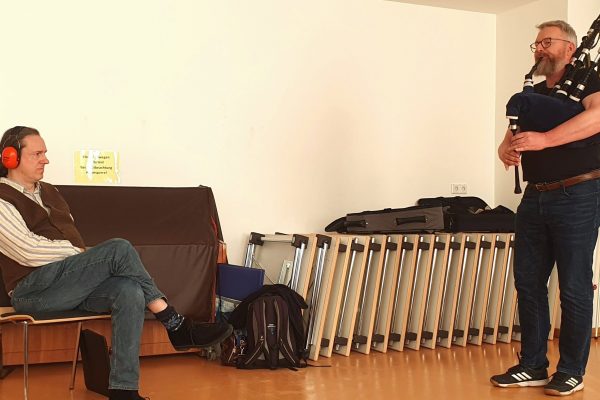
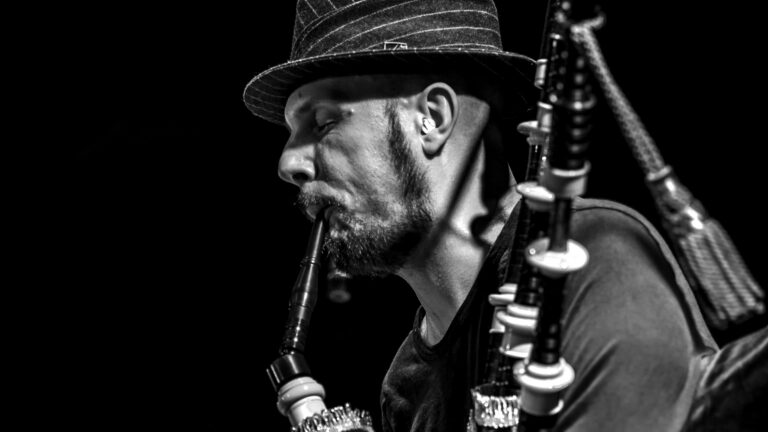
At 8 pm, the screen goes dark. The final lesson on this April evening took place online. Andrew Pattison closes his laptop, picks up his instrument and goes into the next room to warm up. This evening marks the end of his five-day course at the Dudelsack-Akademie in Hofheim am Taunus. To round things off, he will give a recital to a small audience. The first guests are waiting in the corridor.
Pattison – a member of the Inveraray & District Pipe Band – is studying ‘Traditional Music: Piping’ at the Royal Conservatoire of Scotland (RCS) and the National Piping Centre (NPC) in Glasgow. Tonight’s set largely corresponds to the solo programme, lasting around fifty minutes, which he has put together for his exam and will perform for the examination board at the RCS in a few weeks’ time. Like many students before him, he is using this opportunity to rehearse his set list under performance conditions.
Exchange between Hofheim and Glasgow
Every year, around a handful of students from Scotland choose the Hofheim Academy to complete their compulsory work placement there. This is a remarkable figure, considering that the number of piping graduates at the RCS is only marginally higher. This regular influx is down to the connections that Thomas Zöller, founder and director of the Bagpipe Academy, has maintained with these educational institutions for many years. He studied there himself from 2002 to 2005 and continues to maintain numerous contacts within Glasgow’s artistic and academic circles to this day. “Finlay MacDonald, the director of the National Piping Centre, keeps an eye on us. For the students there, it’s an attractive option to do their work placement in Germany and thus gain international experience. Our students, in turn, can take lessons from them and exchange ideas with them”, says Zöller. For Finlay MacDonald, too, the mutual broadening of horizons is a key aspect of this collaboration: “We actively encourage our students to take the opportunity to spend time with Thomas and the team at the Dudelsack Akademie. Each one of our students comes back with a broader mind and renewed inspiration.”
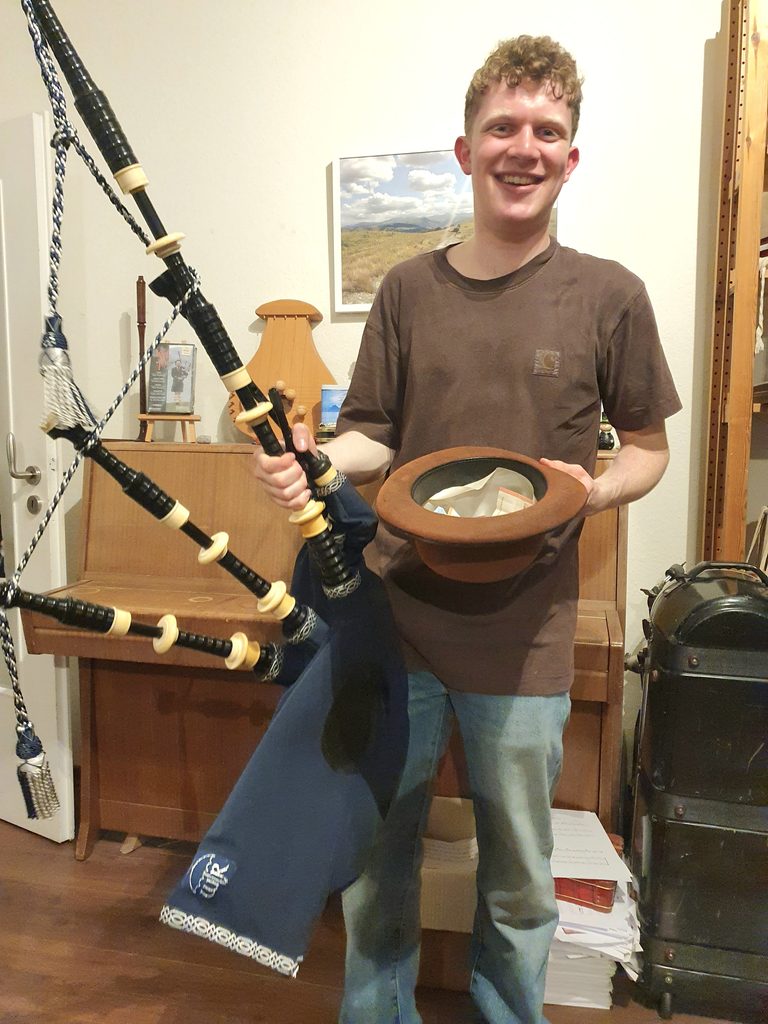
At around 8.15 pm, Andrew Pattison returns to the classroom with his bagpipes under his arm. Around 15 members of the audience are seated in four rows of chairs. Following a welcome and some introductory remarks from the academy director, Pattison introduces himself and begins his programme, consisting of marches, strathspeys, reels, hornpipes, jigs, slow airs and piobaireachd. In between pieces, he offers explanations of the music and shares a few anecdotes. When he is nearly finished, he pours himself a whisky, takes a drink and plays until the end. There is applause, the hat is passed round, and the evening draws to a close in a relaxed atmosphere.
Clichés and a lack of scope
A few weeks later, I meet Thomas Zöller in his training rooms on the outskirts of Hofheim’s old town, just a few minutes’ drive from the outskirts of Frankfurt. In the German piping scene (and beyond), the name Zöller is known to almost everyone who has been involved for some time. However, it is not entirely clear to many where and how this school founder, with his academic background, fits in. Some see him as a headstrong individualist who possesses a high level of specialist knowledge and skill, but who doesn’t quite seem to fit into contemporary pipe band culture.
On the first floor, above a florist’s, Zöller is sitting by the open window; he is wearing glasses with orange lenses. A few days ago, he returned from Glasgow, where he had attended the Piping Live! festival. We get talking about his musical training and how it relates to this school, which he founded in 2005. For five years, he mainly taught himself to play the bagpipes. “My encounters with the Highland bagpipe in this country in the 1990s took place within a stereotypical world shaped by clichés.” By this, Zöller means a particular perspective on the instrument and a highly prescriptive understanding of the music, which he found restrictive. The lack of variation, what he calls “slavish adherence to the score”, and the lack of scope for creative expression – all of this bothered him.
In 2001, he visited the National Piping Centre for the first time to take six weeks of one-to-one lessons. Given his previous experiences, he had some reservations. He thought: if the atmosphere is already so strict in Germany, what on earth must it be like there, in the homeland of this music? But things turned out differently. “Soon after arriving, I thought: ‘Strange, they’re not nearly as narrow-minded as I’d feared.’ Instead, I experienced stark contrasts between my experiences in Germany and what I was taught there,” Zöller sums up in retrospect.
Interpretation rather than reproduction
Born in Hofheim in 1977, he takes his time answering questions. At times, he goes into great detail to explain the background and context. As a conversation partner, you never feel as though you’re being overwhelmed by monologues. In another classroom – the Bagpipe Academy has three of them spread over two floors, plus a recording studio – it suddenly gets noisy. Including Thomas Zöller, there are four lecturers working for the academy. In addition, there are guest lecturers for sessions on specific, in-depth topics. Zöller stands up, closes the door, sits back down by the window and picks up where he left off.
Studying at the Royal Conservatoire of Scotland – then still known as the Royal Scottish Academy of Music and Drama (RSAMD) – opened up a whole new world for him. Among the teaching staff at the time was Allan MacDonald, who from 1995 to 2013 was one of the most influential lecturers in Highland bagpipes and Gaelic music at the RSAMD. Key elements of his teaching included, for example, the historical perspective on piobaireachd (Ceòl Mòr, ‘Great Music’) and the connection between this music and the Gaelic language. An examination of the sources and canntaireachd, as well as various musical styles, were also central to his teaching.
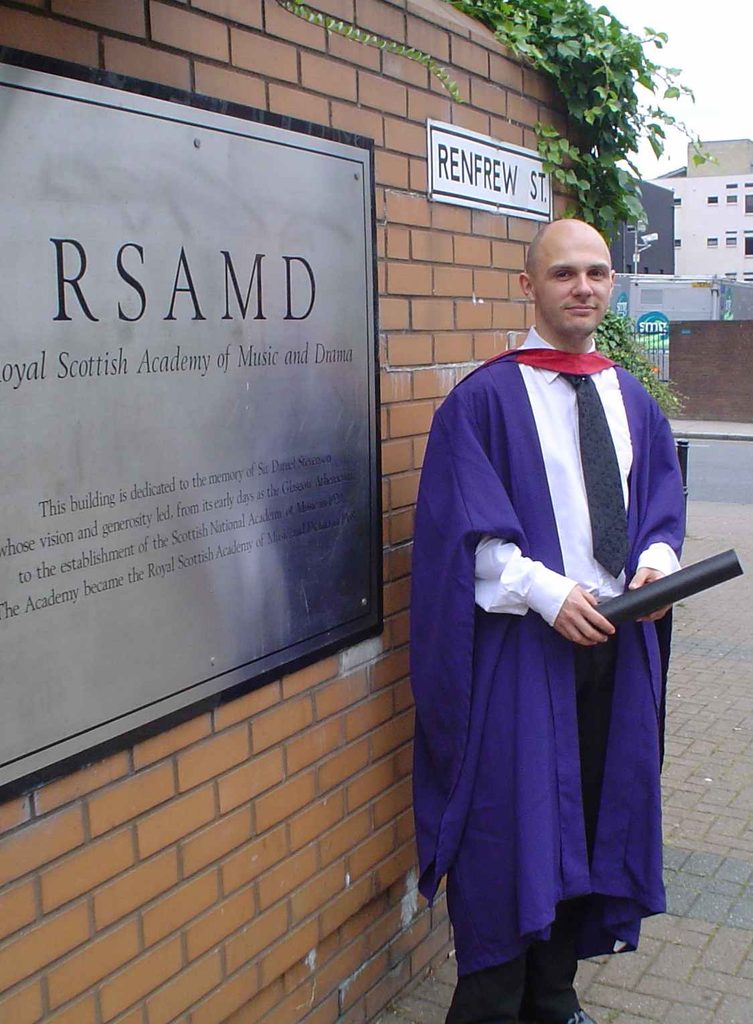
Thomas Zöller is fascinated by this approach, which has given him the freedom he previously felt was lacking. ‘With Allan in particular, it wasn’t about reproducing standardised versions, but rather about developing one’s own musical interpretations. It was this understanding of piping as a living art form and the engagement with cultural and historical contexts that fascinated me. A key moment for me was Allan’s interpretation of the pibroch ‘Glengarry’s March’ on the CD *Ceòl na Pìoba*. After hearing it, I realised that I could learn a completely different way of making music from him – one that went beyond the constraints of convention and the pursuit of trophies.”
To keep this fascination alive and pass it on, Zöller founded the Dudelsack Academy after completing his studies: “I wanted to continue along this path and give people the opportunity to immerse themselves in this world. The impetus for founding the school ultimately stemmed from a desire to convey something of the diversity and depth of musical traditions.”
The tension between freedom and rigidity
He had also played the guitar at one point, though without ‘falling in love’ with it. At some point, he came across drone music. “That’s what drew me in the most of all. A purely tuned instrument played with a drone – it’s simply a fantastic sonic construct with a wide range of expressive possibilities. I’ve been a drone junkie ever since.” For Zöller, it’s always about making the most of these possibilities and breaking new ground with other musicians. He has done this in various ways through several bands, intercultural music projects and artistic collaborations. For example, with the ambitious ensemble Homebound, which operates somewhere on the borderline between world music, jazz and chamber music. The highlight of the repertoire – largely arranged by Zöller himself – is that different musical traditions are brought together using the drone tone as a unifying element.
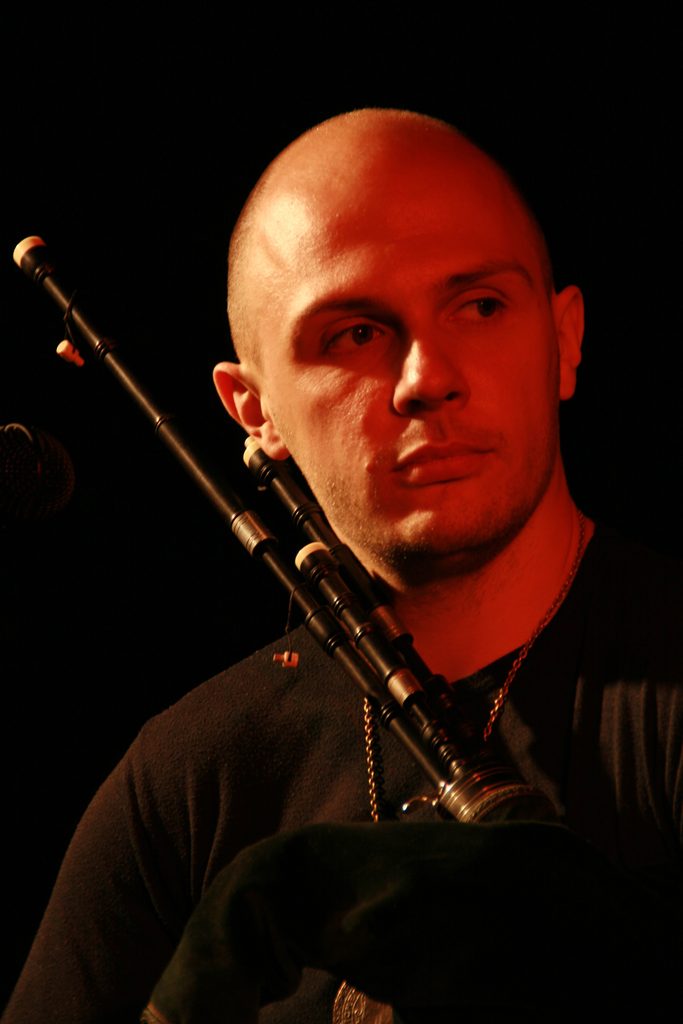
When talking to him about his work, the tension between freedom and convention keeps coming to the fore. To explain this, Zöller outlines the historical background: “It’s actually quite normal for there to be many different variations of a tune. The military played a major role in standardising Scottish pipe music in particular.’ The Battle of Culloden in 1746, which ended in victory for British government troops over the rebellious Jacobites, ushered in a fundamental cultural, political and social transformation for the predominantly Gaelic-speaking Highlands. ‘Out of this chaos, the British military singled out the piper. However, it became apparent that these musicians all played different variations. This was of no use for military purposes. So standardisation was pushed forward.’
‘Everything has its place’
In the December 2024 issue of the music magazine folker, Thomas Zöller published an article in which he explores the wide variety of European bagpipe traditions, with a focus on the Scottish tradition. In this context, he speaks of ‘rigid rules and standardisation within the bagpipe competition culture’, which he claims became established over the course of the 19th century at the expense of ‘musical diversity and stylistic freedom’. This can be read as a critical commentary on a performance practice that is dominant today. In direct conversation, however, the author sounds more conciliatory: ‘Everything has its place and its justification.’ He is far from wishing to pit musical practices and perspectives against one another. What matters to him, however, is the willingness to engage with alternative or overlooked perspectives, to acknowledge them, and to question comfortable assumptions.
Zöller’s open-mindedness and artistic adventurous spirit take him into very different worlds, some of which are far apart. In 2018 and 2019, he performed on several occasions as a soloist with the Bundeswehr Music Corps – the flagship of the German military music service. He then wrote a bagpipe part for a track on the fifth album by the singer, songwriter and producer Mine (whose real name is Jasmin Stocker). They met in the studio to record the song Du kommst nicht vorbei. They later performed together on several occasions.
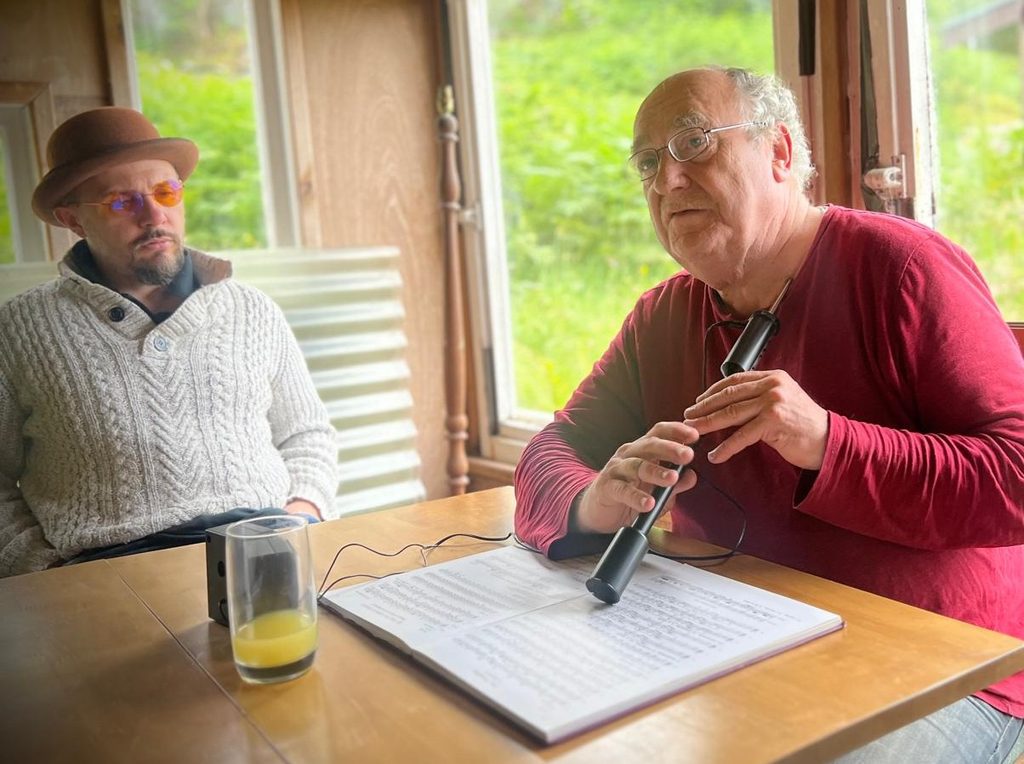
The latest project bears the evocative title ‘Pibroch Unchained’. Together with Allan MacDonald, Thomas Zöller presented it at the Piping Live! 2026 festival in Glasgow. It aims to free classical Ceòl Mòr music from standardised playing styles and instead to reflect on it in the context of its socio-cultural background. To this end, MacDonald has reinterpreted and recorded the 264 pibrochs from the 16 books of the Piobaireachd Society. The two initiators hope that the editing and publication of the resulting material (more than 40 audio CDs) will provide valuable impetus and fresh perspectives on ‘great music’. A crowdfunding campaign has been launched to bring this ambitious project to fruition.
Finding freedom
Allan MacDonald is perhaps the figure who has had the greatest influence on Zöller’s musical career. In the 1990s, MacDonald began to challenge the traditional competition establishment by questioning the established rules governing what constituted a ‘good’ and ‘correct’ interpretation of a pibroch. Whilst the ensuing controversies over interpretative authority, musical tradition and institutional authority form part of a very specific specialist discourse, they also exemplify broader questions concerning normativity, legitimacy and our relationship with art. At its core, MacDonald’s approach could be summarised as simply seeking to highlight the possibility of different paths, without setting new standards.
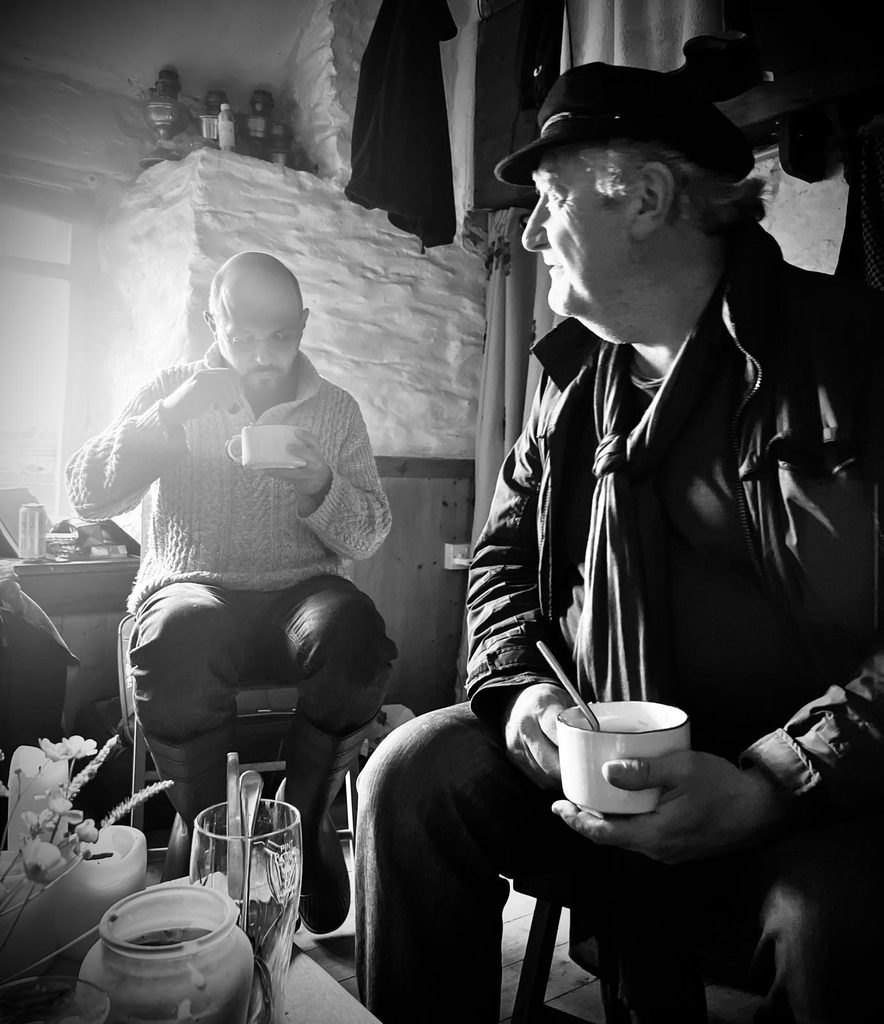
This approach was very well received by Thomas Zöller, and to this day it remains something of a guiding principle for his teaching and creative work. A key concept here is ‘tradition’. It serves as a frame of reference for a vibrant and diverse world of musical expression, free from the standardisation imposed by institutional approaches. When the founder of the Dudelsack-Akademie speaks of these matters, he draws on metaphors: ‘Tradition is like a ceaseless river that one can view both upstream and downstream. It is important to me to study its source and the landscapes it has already flowed through.’ Zöller shifts this perspective of an observer on the bank as our conversation progresses. He then speaks of tradition as a ‘current’ into which we could step in order to become part of it.
To be part of something greater through music, to lose oneself in it, perhaps even to disappear – an image that fits Thomas Zöller rather well. He is not the sort of person who pushes himself loudly into the limelight. Self-promotion via social media? Not a chance. He once said: ‘The less of “me” there is in the music, the more at ease I feel.’ Putting the ego aside to some extent. An almost outmoded act. And perhaps also a way to find freedom.
Cover photo: Heiner Breuer